

What Low Water Reveals
A Danube essay on memory, loss, and the systems we depend on -- because it turns out there is more depth to the lack of water. Join our discussion in the comments section


The river is not supposed to disappear in plain sight.
It all seems too sudden for a mother of three (me!) who is not usually up-to-date with political intrigues and the daily craze of media, news, propaganda and general noise. I am already over stimulated by my kids, so in my free time I usually take nature walks with Dr. Gabriella Kőrösi , write books and essays (like this one), jog with a friend, travel, do art, cook From My Kitchen Table, and so on. I avoid reality, one might say, at least the social media one. Plus, my mental health has priority.
I first noticed the news on Facebook, of all places.. I had even limited my time there by deleting the app, trying to make some room for mindfulness and to avoid the doom-scrolling. But the story found me there anyway. Stories usually do find me when they matter. This one is one of them.
This summer, the Danube waters are thinning into a lifeline, it is still alive, but barely. We blame it on the heat, don’t we? As if the water could simply return when the heat breaks. Still, the heatwaves continue to come one after the other. I even heard someone wishing it were fall already, to get some rain and cooler weather and, of course, our rivers back.
Sadly, the truth is more unsettling than that. Low water depends on a chain of events or on small breaks in the usual state of things. There have been, apparently, strange disruptions, like when a ship carried less freight, a lock took longer, a ferry paused, a reactor reduced its output, or a barge waited a little longer where it used to pass (because the river no longer gives it the same passage). The sand dunes appear now here and there at the edges. While it is an unusual view, people are getting used to it. Big rocks are visible, and even so-called treasures suddenly become visible where before there was just deep dark and flowing water.
The river is still there, just not doing all the work we once relied on it to do. It’s like it got tired. Its tiredness tries to warn us of something bigger. I wonder about the smells, does it smell like fish? Where did the fish go?
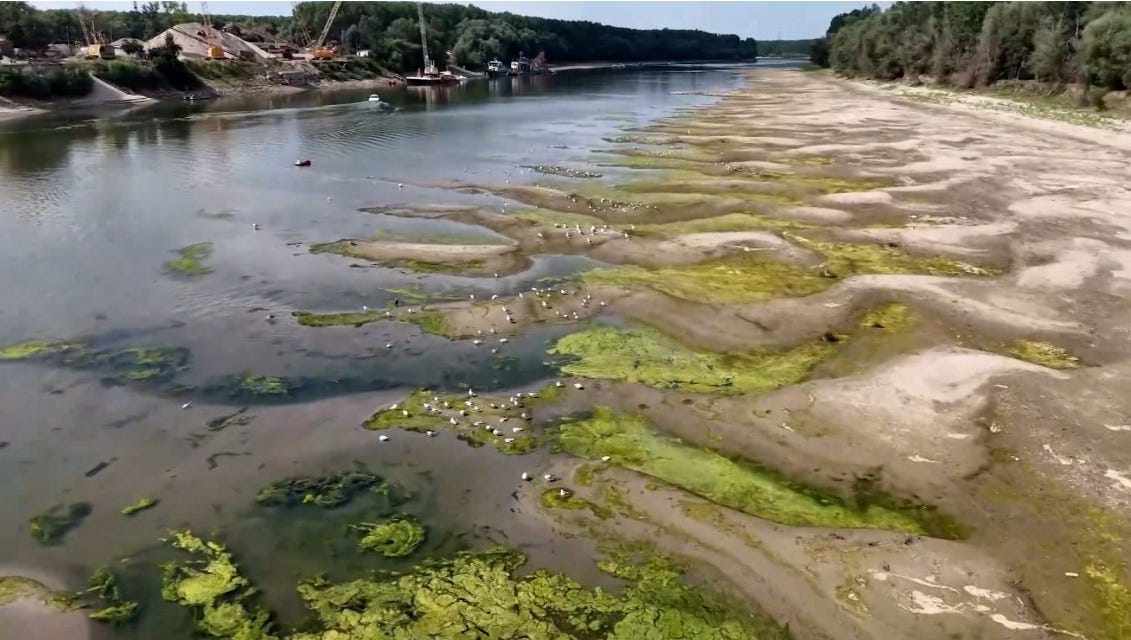
Along the Danube, across borders and through systems that usually remain invisible, low waters tell many stories. We just need to watch carefully and listen with our senses. There can be more approaches when “observing” what has been happening lately.
In Germany, waterways authorities said low-flow conditions had returned. The Danube currently has the worst affected waterways.
In Austria and Slovakia, navigation slowed. Shipping companies adjusted timetables or reduced loads.
In Serbia, barges and tankers were forced to carry less than usual.
In Romania, low water brought irrigation restrictions and pressure on nuclear cooling systems. Actually, there are talks of completely stopping the hydro plant at Cernavodă and even of blackouts.
In Hungary, the Paks plant (it supplies nearly half the country’s electricity) is under pressure or in danger of shutting down because the river cannot be relied on for cooling.
These are the same crises moving through different places, across countries, flowing one into each other, just like the Danube has been flowing for ages. But where is the water?
Low water shows clearly the needs of daily life. Cargo needs depth of water to flow on the river. Energy needs cooling and water is paramount in the cooling system. Farming needs irrigation with water from the river. River cruises and leisure activities on boats need passable routes. Ecosystems need balance between water levels and more. It’s all becoming more complex than any person might have thought. If we dig into this it all sounds logical, doesn’t it?
When the water level is very low, the river loses its capacity to buffer us. It looks like the seams in everything we have built around the Danube begin to show.
I wonder how it is in other countries, where other major rivers flow. Do they also experience severe climate change? Let me know in the comments, let’s connetc on this topic.
The whole chain of systems across countries now already looks and feels conditional and fragile.
There are many scenarios, of course, but the best one would be rain. We don’t need more heatwaves, we don’t need to wait longer. A future where low water becomes the new normal sounds bleak.
There is also the ecological cost. In shallow, warmer water, pollutants become more concentrated and oxygen levels fall. Meanwhile, fish, wetlands, and other living systems will be under pressure. They already are!
From a distance, the river may still look beautiful, intriguing, though not the same strong river we used to know. If we look closer, it is suffering. This seems to be climate stress, appearing gradually. It’s been changing the terms of life under our very eyes, and we still haven’t noticed it in due time. or else we might have interfered earlier?
There is another kind of exposure which drew my eyes. Again I heard about it first on Facebook and then researched it. Imagine, a motorcycle from the Second World War surfaced from the mud in Budapest! Sunken Nazi-era warships reappeared near Serbia. Mammoth bones emerged in Bulgaria. These discoveries feel surreal, like in a movie.
The river is now the main character in this complex narrative. It is offering us its buried memories for us to see, to notice, to react. Memories of a not too distant history resurface and might make us wonder:
Are the systems we have chosen still fit for the world we are living in, or are we only now beginning to see how easily history can repeat itself?
Of course, the river is not being sentimental in real life. This is my interpretation, since I tend to reflect as much as I report.
The river is not giving us relics as gifts, not really. These so-called treasures can be dangerous, as the recent discoveries of unexploded mines and grenades make clear.
What the river is most likely showing us is what becomes visible when the cover slowly thins, almost disappearing. Now, with the record low water level, the river reveals the past and also the cost of the present.
The Danube has become a living system of dependencies.
Every weak point touches another, like a line of falling dominoes. This is not a game, unfortunately. A chain reaction starts when a slower lock delays a shipment and then consequently, a shallower channel raises costs. Stressed power plants expose energy systems already under pressure. Last but not least, a dry bank transforms memory (or memories) into hazard. Because what was buried and resurfacing are war remnants, like rusted metal, and old explosives, no longer safe once the water pulls back.
People are curious and intrigued. The same happens when the river floods, you know, curiosity makes people do wild things. The Danube flooded in Budapest not too lng ago, a few years back, yet it feels like a long time ago.
The river is teaching us presently a lesson in connectedness. And guess what? Modern life often prefers not to hear it: connectedness also means responsibility.
These low waters feel very important to me nowadays. How do you feel about it?
I got obsessed with the subject of water and what is really going on in the countries along the Danube. Why and how we got to this point where the river is not doing its seamless work, flowing and supporting the systems in its channels like it’s been doing for centuries.
The river no longer hides what lies beneath its waters. This is not the whole story, it’s more complex for sure.
I’m crying because if we really look deeper, the Danube is still alive and tries to show us what we have built, what we have ignored, and how fragile the present becomes.
Listen to me clearly, please, because it just feels like the water stops behaving. Climate change is happening, and low water reveals the price of the present.
Thank you for reading. I appreciate you.


Join DEP’s Morning Coffee/Tea with Gabriella every Monday at 8 am PST. Send us an email to receive an invite.
Amazon Affiliate links to recommended DEP books:

Gabby, it is so painful to read about the low water levels in the Danube. I believe that we need to plant more evergreen trees as a society to support the cycle of increased water and oxygen on our planet. While it is intriguing to find things from the past in the water, it is also very sad that they ended up there in the first place. I hope rain comes soon and water levels return to normal. I think globally we have to be more responsible and mindful about our environment. Without water, we die. Thank you for writing about this important environmental issue.
I have heard about low water levels in the rivers in Germany even though I have been around briefly. It's painful to think how complete ecosystems that we don't even account for are disappearing as a result of this. It frustrates me so much that politicians and power mongers are still raging on issues with least relevance as our natural habitats die bit by bit.
In India it is the same or worse. Unpredictable weather, dying forests, and rivers. Once in a while nature's fury lashes, explodes in retribution, and wipes out millions. Honestly scared for our kids and future generations